How to play · Layout
City builder road layout: grids, blocks and frontage
In a big traffic simulator, road layout is about congestion. In Cashmate, as in many city tycoons, there is no traffic: what a road layout decides is how many tiles can hold a building and how much of your land and money disappears under asphalt. This guide compares the common layouts tile by tile, using the placement rules of Cashmate, a free city builder you can try in your browser.
The short version: for small buildings, parallel streets with two rows of buildings between them waste the least land. A grid with blocks three tiles wide suits a mix of sizes. Wider blocks leave tiles in the middle that no small building can use.
The rule that decides every layout: frontage
In Cashmate a building needs a road tile directly beside one of its sides. A road touching only a corner does not count, and a building that loses its road closes. There is no traffic, and a road does not have to connect to the rest of your streets: one short stub beside a building is enough. So the question for every layout is simply which tiles have a road beside them.
Call those tiles frontage. A small building of 1 × 1 tiles needs one of its own. A 2 × 2 building needs a road beside any of its edge tiles, and a 3 × 3 building the same, so bigger buildings can sit deeper in a block. Everything below follows from that.
Road spacing compared
The table lays each pattern over open land and counts, with the game's own placement rule, how the land is split: tiles under road, tiles a small building can use, and tiles with no road beside them.
| Layout | Road | Usable by small buildings | No road beside |
|---|---|---|---|
| Grid, a road every third tile (2 × 2 blocks) | 56 % | 44 % | 0 % |
| Grid, every fourth tile (3 × 3 blocks) | 44 % | 50 % | 6 % |
| Grid, every fifth tile (4 × 4 blocks) | 36 % | 48 % | 16 % |
| Parallel streets, every third tile (strips two deep) | 33 % | 67 % | 0 % |
| Parallel streets, every fourth tile (strips three deep) | 25 % | 50 % | 25 % |
A few things stand out:
- A tight grid wastes land on road. A road on every third tile in both directions gives every tile frontage, but 56 % of the land is road and only 44 % holds buildings.
- Blocks three tiles wide are the balanced grid. A road every fourth tile leaves 50 % of the land for small buildings and only 6 % without a road: the centre tile of each block.
- Wider blocks waste the middle. With a road every fifth tile, 16 % of the land has no frontage. Those tiles can only take buildings big enough to reach a road from there.
- Parallel streets win for small buildings. Streets on every third row, with no cross streets, put only 33 % of the land under road and give the other 67 % frontage: two rows of buildings back to back between each pair of streets. Space them every fourth row and the middle row of each strip, 25 % of the land, has no road beside it.
Money follows land. For every hundred tiles of land you lay out, the parallel streets cost 333 coins of road and the three-wide grid 438, plus a little upkeep per tile, forever.
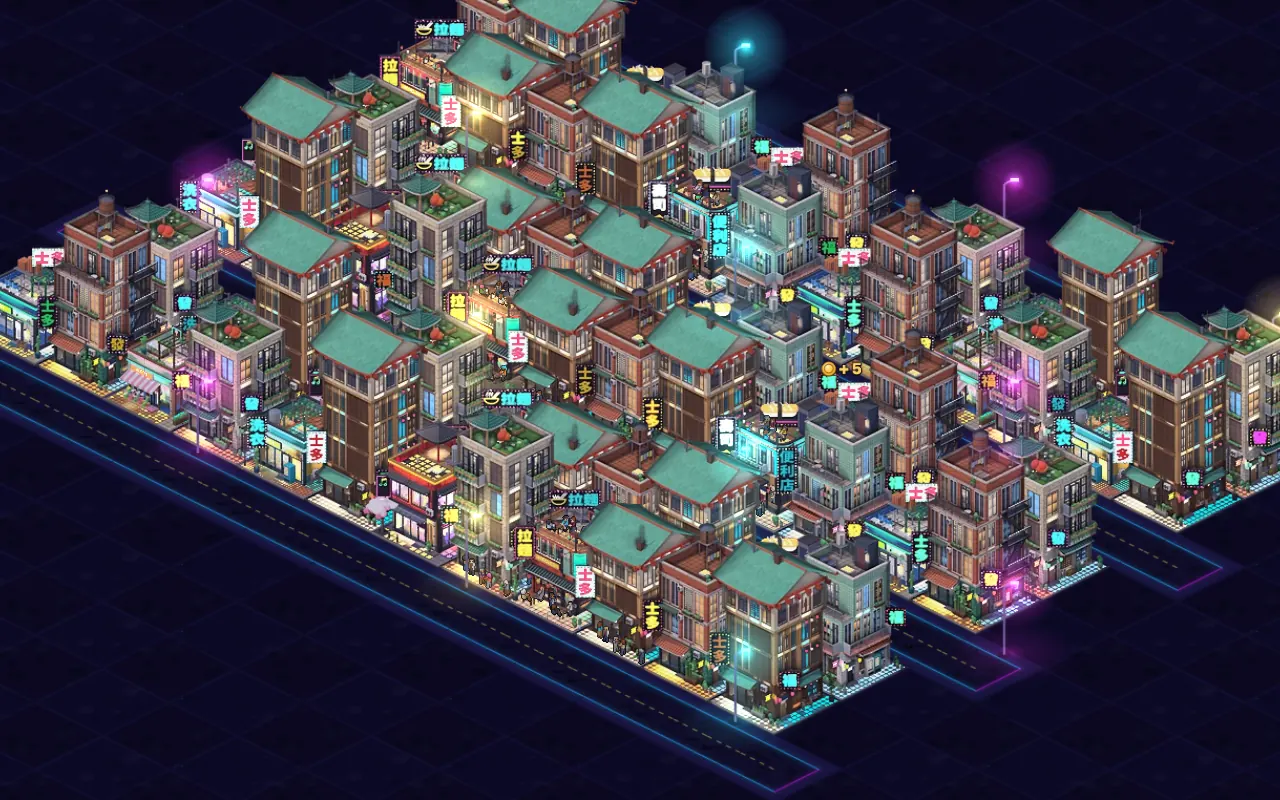
How to fill a block three tiles wide
A block of 3 × 3 tiles ringed by road has eight edge tiles with frontage and one centre tile without. Three good ways to fill it:
- Small buildings round the edge. Eight homes or shops, the centre left empty.
- One 2 × 2 building in a corner and five small ones on the tiles left over. The big building covers the centre, so no tile is wasted and every building still reaches the road.
- One 3 × 3 building that fills the whole block: in Cashmate that is the Circuit Works, the City HQ and the Central Station.
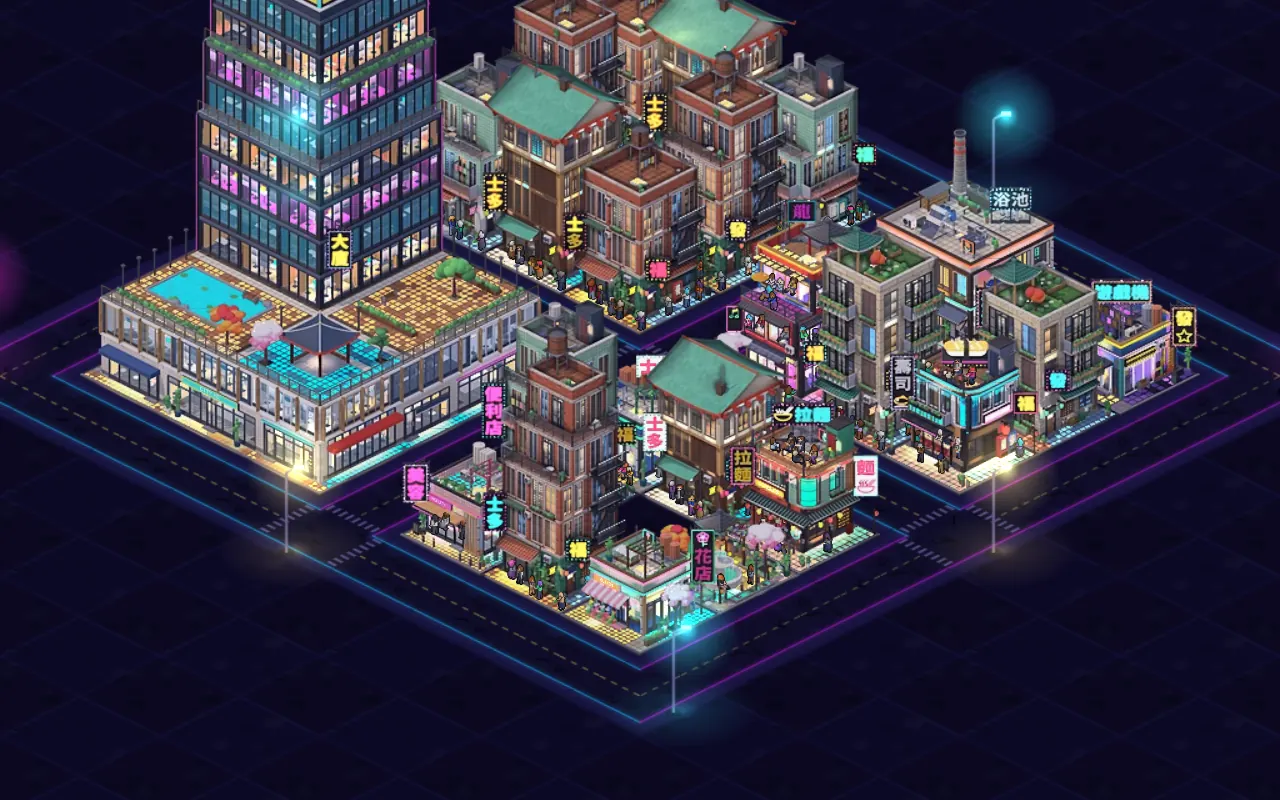
Dense blocks and happiness
Packing homes tightly has a price in most city builders. In Cashmate every home within 2 tiles of another takes 4 happiness points from it, up to 24, while each road tile beside a home adds +2, up to +6. A corner home with road on two sides gets +4; one with road on a single side +2. Happiness then scales how much each resident spends.
Take one block three tiles wide, on its own, filled three ways:
- Homes on all eight edge tiles: 80 residents at an average happiness of 29.
- Homes on the four corners only: 40 residents, happiness 42.
- Seven homes and a park: 70 residents, happiness 37.
Multiply residents by what their happiness lets them spend and the full block still comes out on top (63 against 37 for the corners), with seven homes and a park close behind at 61. The lesson: fill blocks, but a park in a dense block costs you almost nothing in spending and lifts every home around it. Keep the noisy Circuit Works away from homes: it takes 8 points from every home within 3 tiles.
Distance still matters: reach and commutes
No traffic does not mean distance is free. A shop sells only to homes within its reach, from 6 tiles for the Sushi Bar up to 14 tiles, and hires only from homes within 10 tiles. A layout that puts all homes in one corner and all shops in another leaves shops without customers. Mixed streets, with a shop every few homes, keep every home in reach of every market.
Laying roads in practice
- Start from the streets you have. Cashmate starts with 16 tiles of road, a main street and a cross street. Extend them rather than starting a second network.
- Draw a stroke at a time. Drag with the Road tool: road costs 10 coins a tile, the label at the end of the stroke shows the length and price, and tiles that cannot take road turn red with the reason.
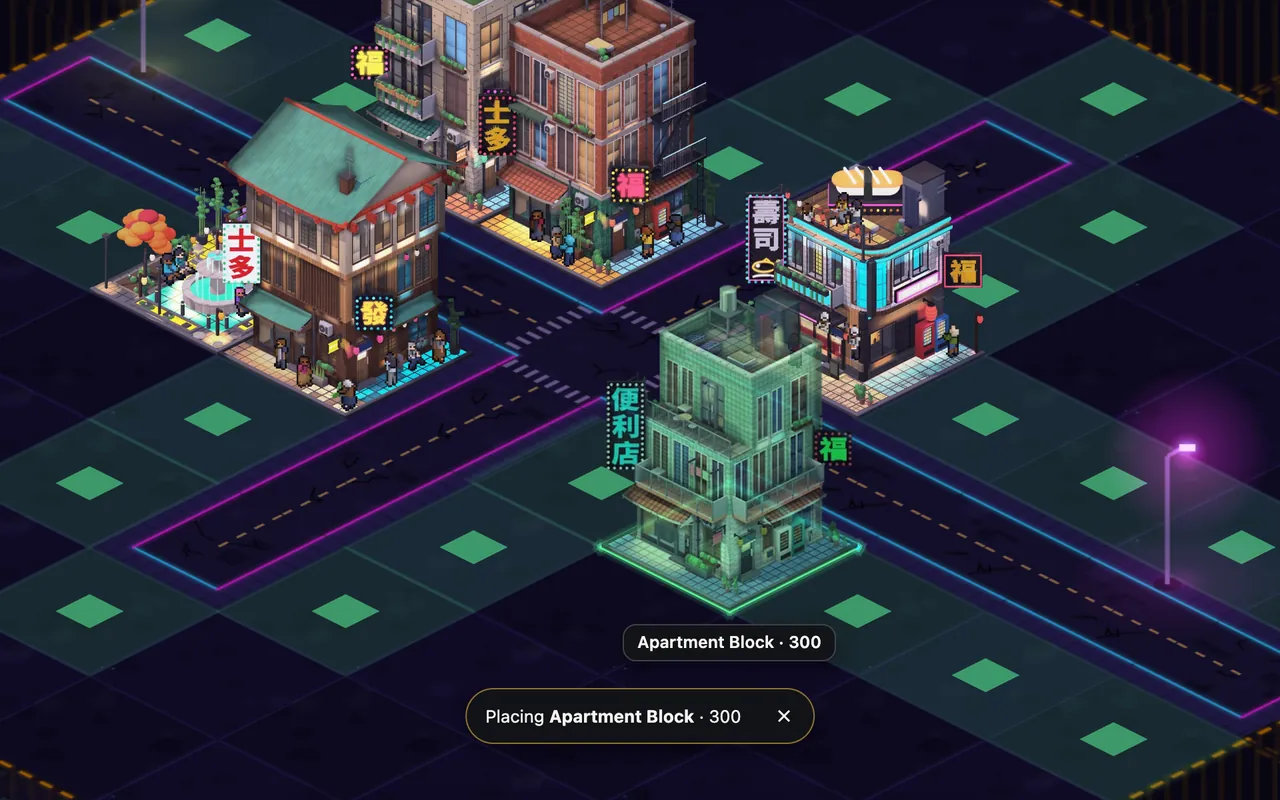
- Let the game show you the frontage. When you pick a building, every spot where it fits is tinted and the road edges it would touch light up.
- Plan across plots. Road can only go on land you own, so buy the plot a street should run into before you draw it.
- Change your mind cheaply. The Bulldozer removes road for 5 coins back per tile, and buildings that would lose their only road light up before you let go. Within 10 seconds, undo returns every coin.
Once your streets are set, the next question is what to put along them: the beginner tips cover homes, shops and markets.
More guides
The road rule, plots and every building's size: the Cashmate player guide.
-
City builder tips for beginners
Ten rules for your first city: roads, homes, shops, markets, happiness, upgrades and land.
-
How to price items in a tycoon game
Demand, the best price, stock and competition, worked through one real shop.
-
Idle games with offline progress: how to use it well
What keeps running while you are away, the cap, and what to do before a break.
-
How to play a city builder in your browser
No download, no account: what you need, the controls, saving and your first minutes.