How to play · Beginner
City builder tips for beginners
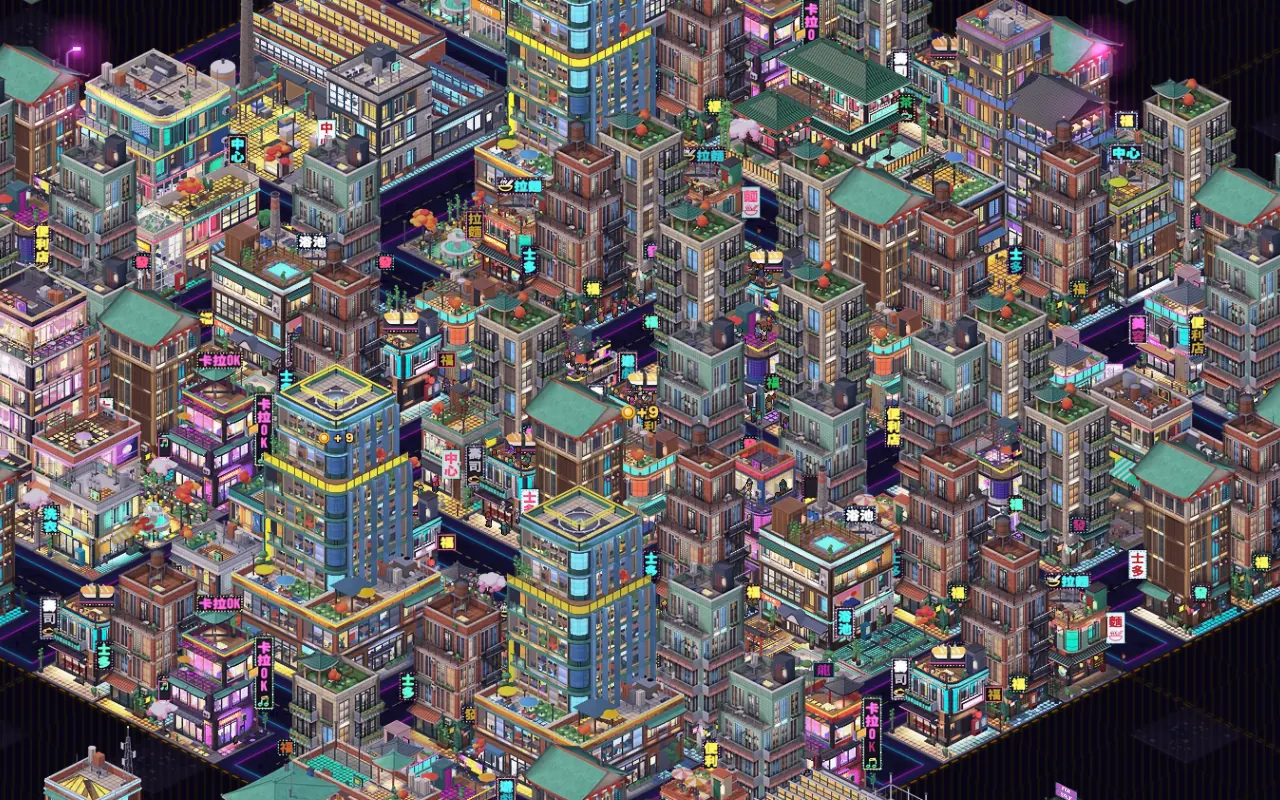
Most city builders share the same few rules: streets come first, homes feed shops, and the cheapest growth is rarely more of the same. Here are ten tips that work in almost any tile-based city builder or city tycoon, each one shown with real numbers from Cashmate, a free city builder you can play in your browser while you read, and a note on the first hour.
The short version: lay roads before buildings, put homes and shops close together, open a new kind of shop before a second copy of one you have, keep homes happy with parks, set your prices, upgrade when land runs short, and follow the goals.
1. Build roads first, and only as much as you need
In nearly every city builder a building is useless without a street. In Cashmate the rule is strict: a building must have a road tile directly beside one of its sides, or you cannot place it at all, and a building that loses its road closes until you draw a new one. A road that only touches a corner does not count.
Road is cheap but not free: 10 coins per tile to build and a small upkeep of 0.06 coins per tile every minute. The city you start with already has 16 tiles of road, a main street and a cross street, so your first job is not to pave the map but to extend those streets one stroke at a time, right before you build along them. How far apart your streets should be is a question of its own: the road layout guide compares the options tile by tile.
2. Homes feed shops: keep them close
Homes bring residents. Residents are your workers and your customers at once: half of them work, everyone shops. A shop hires from homes within 10 tiles and sells to homes within its reach, which runs from 6 tiles for small shops like the Sushi Bar up to 14 tiles for the Circuit Works. A shop with only half its workers makes half its output; a shop with no home in reach sells nothing at all.
So the first habit is simple: build in neighbourhoods. A row of homes with a shop at the end of the street works; a shop on a lonely road at the edge of your land does not. When a building has a problem (no road, no workers, no customers), Cashmate puts a badge on it and the panel tells you the fix.
3. Open a new kind of shop before a second copy
This is the tip beginners miss most. Shops sell into markets, and in Cashmate there are five: food, fun, care, work, goods. Every home shops in each market that has a shop in reach. Two shops of the same market share the same customers; a shop of a new market finds customers nobody was serving.
Here is the difference with the game's own numbers. Your starting city has 30 residents and one Sushi Bar. Once the head start of the first hour is over (more on that below), it makes 15.8 coins a minute after upkeep. There is a free corner right across the crossing. Compare two ways to use it:
- A second Sushi Bar (520 coins): both bars now split the same customers. Each sells only 3.2 portions a minute at a best price of 4 coins, and together they take 25.3 coins a minute, about what one bar took alone. Add the second bar's upkeep and your city's net income falls to 11.1 coins a minute.
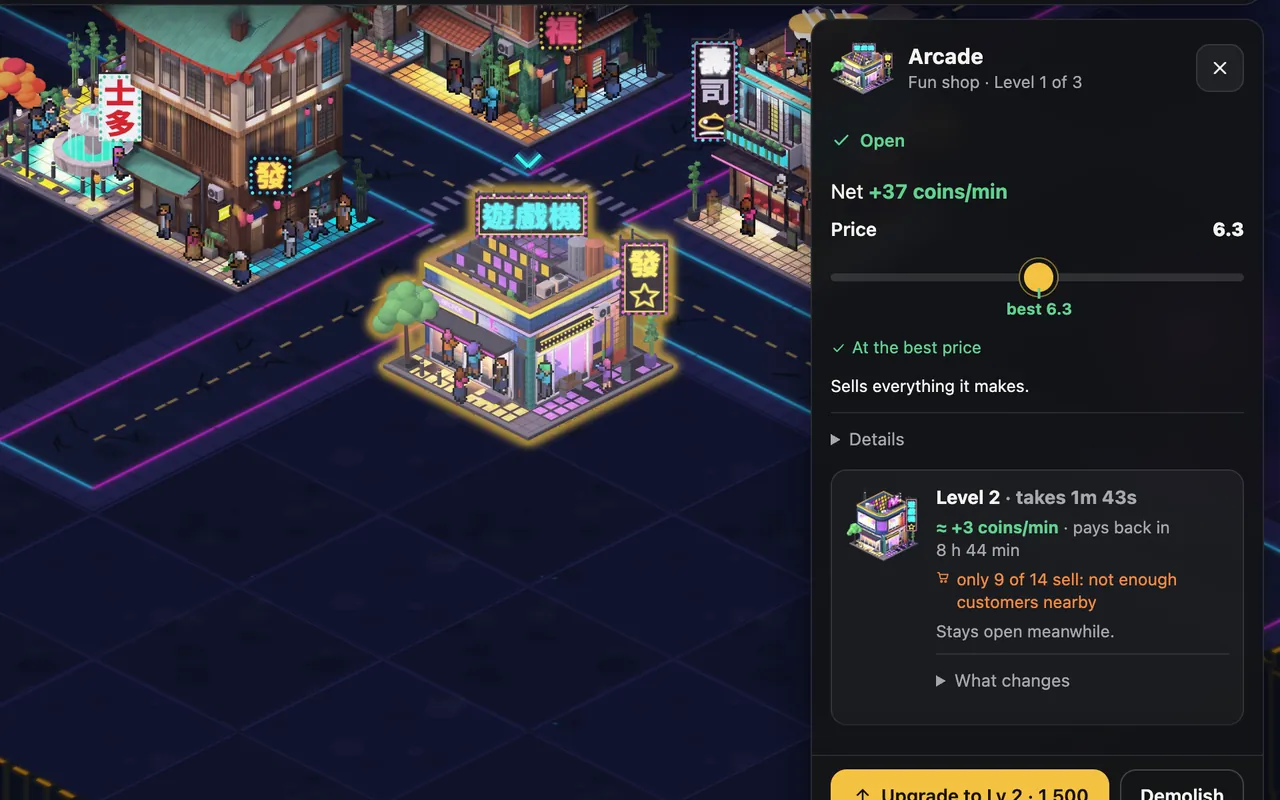
- An Arcade (600 coins): it sells into the fun market, where the same residents have spent nothing yet. At its best price of 6.3 it takes 45.4 coins a minute, and the city's net income rises to 52.6.
Same corner, same residents, a few more coins spent, and the city's net income more than triples. A second copy of a shop makes sense later, in a part of the city the first one cannot reach.
4. Expect every copy to cost more
Many city builders and idle tycoons raise the price of each further building of a kind, so a city cannot simply be stamped out. In Cashmate, each further home costs 6 % more than the one before, each further shop of the same kind 30 % more, and each further community building 35 % more. The first four Sushi Bars cost 400, 520, 680 and 880 coins; the first four Apartment Blocks only 250, 270, 280 and 300. The buildings you start with count as copies, which is why your next Sushi Bar costs 520 and not the first one's price.
Homes stay cheap for a long time; shops of one kind get expensive fast. That pushes you towards the tip above: variety, not repetition.
5. Add homes when your shops sell out
More homes mean more workers and more customers. In the starting city the Sushi Bar already sells everything it makes, so one more Apartment Block (300 coins) brings no extra portions to sell. What it brings is demand: with 40 residents instead of 30, customers will pay more, the bar's best price rises from 4.2 to 5.1 coins, and the city's net income goes from 15.8 to 20.6 coins a minute.
Residents also unlock new buildings. The Karaoke Bar opens at 40 residents, the Noodle House at 50, the Beauty House at 70, the Bath House at 100 and the Office Block at 120. The build menu always shows what comes next and how many residents it still needs.
6. Keep homes happy, but know when it pays
Happiness is the multiplier on everything your residents buy. In Cashmate every home starts at 50 points. A park within 3 tiles adds +8, a road beside the home adds +2 per road tile (up to +6), and every other home within 2 tiles takes 4 points away (up to 24 in all). Residents of a miserable home spend at ×0.5, those of a perfectly happy one at ×1.5.
A second Fountain Park (270 coins) on that free corner lifts the starting city's happiness from 53 to 61, and the Sushi Bar's best price from 4.2 to 4.5. Yet net income moves from 15.8 to 15.7: the bar already sells out, so the extra spending only covers the park's own upkeep. Parks pay when there are shops with room to sell more, usually once a few markets are open. Build them between homes, not instead of shops.
7. Set your prices, then check them again
In a tycoon game the price is the cheapest lever you have. Cashmate's price slider marks the best price, the one that earns the most coins a minute, and a new shop opens at it. But the best price moves as the city grows: the new home above raised it without anyone touching the slider. When a shop's price is off, its panel offers Use best price and says how much more it would earn. The pricing guide explains the demand curve behind it.
8. Grow wide first, upgrade when land runs short
Upgrades raise a building's residents, output or appeal on the same tiles. An Apartment Block houses 10 residents, 24 at level two and 44 at level three. Early on, a new home is the cheaper way to grow: about 30 coins per resident, against about 100 for the first upgrade (it costs 1,400 coins for 14 more residents). Upgrades win once you are short of land, because land gets dearer with every plot you buy.
A building stays open at its old level while it upgrades. Level three needs a City HQ: it unlocks at 120 residents, costs 15,000 coins, and a city can have only one.
9. Buy land next to what you have
Your downtown of 10×10 tiles is free; the rest of the 32×32 map is sold in 64 plots. A plot costs 60 coins per tile, each ring further out adds 50 %, and every plot you already own makes the next one 23 % dearer. A 5×4 plot next to downtown costs 1,800 coins as your first purchase and 5,070 after 5 purchases. Buy plots that touch your streets, so the first stroke of road already gives you building spots.
10. Follow the goals, and use undo
If a city builder has a goal track, follow it at first: it teaches the rules in a sensible order and pays for the lesson. Cashmate's first chapter has 5 goals (Extend the road, Build a home, Build an Arcade, Check your Arcade’s price, Place a park next to homes) and pays 1,280 coins in fixed rewards for them, about what those purchases cost. Rewards are never random. The browser guide walks through that chapter step by step.
Mistakes are cheap too: every building, road, upgrade or land purchase can be undone within 10 seconds for every coin back. Try a spot; if it looks wrong, undo it.
A note on the first hour: income drops, and that is fine
Some tycoon games give a new city a head start. In Cashmate every shop makes and sells ×3.5 its normal amount at first; the bonus shrinks every minute and is gone after 60 minutes of play (the city's own clock, which also runs while you are away). A ✦ next to your income shows it is still on. When it ends, income falls to the normal rate. That is expected, not a mistake, and all the numbers in this guide are for the city after the bonus. It counts time away too, which the offline progress guide explains.
More guides
Every rule and building in one place: the Cashmate player guide.
-
City builder road layout: grids, blocks and frontage
Grid or parallel streets? Road spacing compared tile by tile, and how to fill a block.
-
How to price items in a tycoon game
Demand, the best price, stock and competition, worked through one real shop.
-
Idle games with offline progress: how to use it well
What keeps running while you are away, the cap, and what to do before a break.
-
How to play a city builder in your browser
No download, no account: what you need, the controls, saving and your first minutes.